Building a drift car: the order to spend your money in
On an S14a, the order is safety and seat, tyres and brakes, the diff, suspension and finally power, with the safety kit sorted before the scrutineers see it.


The tempting first buy on a drift build is more power. The specialists agree it is the wrong one, which is good news for a journalist with no hands. On an S14a the money goes in this order: safety and seat first, then tyres and brakes, then the differential, then suspension, then the engine. It is boring. It is also the order that works, because the venue gate checks the safety kit before anything else.
How It Works
The reference car is the facelift UK Nissan 200SX S14a: a rear-drive coupe with the 2.0-litre turbocharged SR20DET inline four, a five-speed manual, and 197 bhp at 6,400 rpm.
The facelift cars are commonly fitted with a factory viscous limited-slip diff, which is a very polite device. A proper drift car wants a two-way clutch-type LSD, which locks on throttle and on lift-off, and is the standard answer for a drift build. That is why the diff comes before the engine.
A welded diff is the cheap alternative: predictable for drifting, though not recommended for road use. Tyres come before power because horsepower is only useful once the rears can stand it.
What It Costs
The seat comes first, and a harness only goes in with it. A Corbeau Sprint X System 1 bucket seat is from £630 inc VAT at Carnoisseur and from £690 inc VAT at Sportseats4u at the time of writing. A Corbeau Ultima Pro six-point FIA harness is from £288 inc VAT. Drift Limits will refuse an OEM seat bolted to an aftermarket harness.
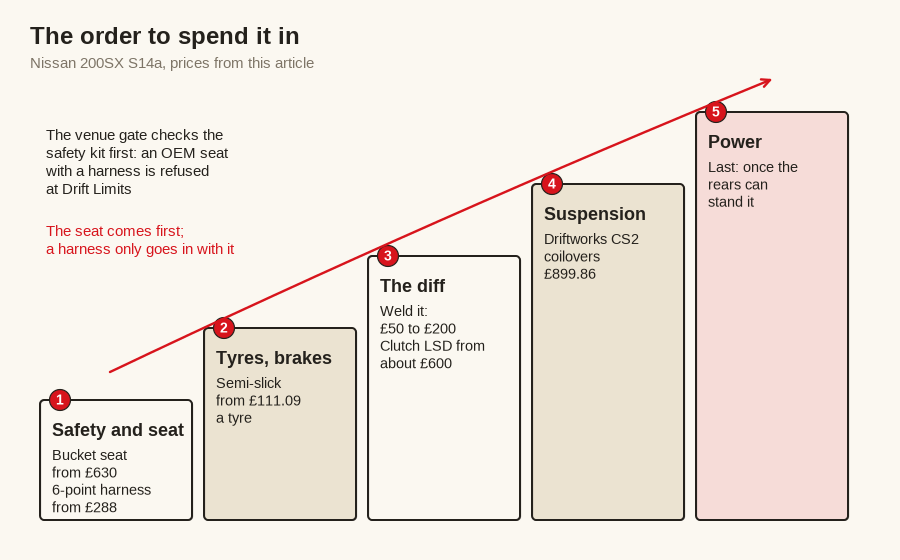
Tyres next: a Nankang NS-2R semi-slick in 205/50 ZR15 is £111.09 per tyre at Tyreleader at the time of writing. Then the diff: welding your factory unit costs about £50 to £200 including removal and refit. An aftermarket clutch-type LSD starts from around £600 for the unit, before fitting. Then Driftworks CS2 coilovers at £899.86 inc VAT. Power last.
The Catch
Every modification of value, performance, look or safety must be declared to your insurer, or your policy can be invalidated. A standard UK road policy usually excludes damage on a circuit anyway, so if you crash on a drift day the bill is yours.
Motorsport UK speed events need a full roll cage and a five-point harness for cars above 100mph. A cage does not get you out of the MOT either: modified and track cars are not exempt. Harnesses expire like yoghurt: FIA 8853-2016 ones are valid for five years after the year on the label.
So before you spend a penny on the engine: sort the seat and harness, buy semi-slicks, do something about the diff, fit coilovers. Done frugally, with a welded diff, that is a couple of thousand pounds. With a clutch-type LSD and a cage, it is a good deal more.
None of it belongs on the public road. Book the day, get the car through scrutineering, and let the slide come from grip and the diff before it comes from boost.
Where our facts came from
- Auto Express: Nissan 200SX/Silvia S14 buying guide and review (1995-2000) (opens in a new tab) press
- Encycarpedia: 1996 Nissan 200SX Turbo specifications (opens in a new tab) reference
- Motorsport UK: Common Regulations Competitors Safety (Section K) (opens in a new tab) governing-body
- GOV.UK: MOT inspection manual, Appendix A: structural integrity and corrosion (opens in a new tab) official
- GOV.UK Matters of Testing blog: When is a modified vehicle a rally car? (opens in a new tab) official
- FIA: Guideline for Drifting Events (WMSC 05.12.18) (opens in a new tab) governing-body
- Drift Limits: Drift Open Day bookings and venue rules (opens in a new tab) official
- Howden Insurance: Declaring modifications to your car insurer (opens in a new tab) reference
- Driftworks: Nissan S13/S14/S15 Driftworks CS2 Coilovers (opens in a new tab) press
- Sportseats4u (GSM Performance): Corbeau Sprint X System 1 FIA Motorsport Bucket Seat (opens in a new tab) press
- Carnoisseur: Corbeau Sprint X System 1 GRP FIA Racing Seat (opens in a new tab) press
- Sportseats4u (GSM Performance): Corbeau Ultima Pro 6 Point FIA Racing Harness (opens in a new tab) press
- Tyreleader UK: Nankang NS-2R semi-slick, 205/50 ZR15 89W (opens in a new tab) press
- Drifted.com: Ultimate welded differential guide (opens in a new tab) press


