Drift geometry: camber, caster and toe, explained on an S14
Long before a turbo, a drift car wants a pair of arms and a proper alignment, with caster the angle to understand first.


The Nissan 200SX S14a is a usefully ordinary place to start this. SR20DET, rear drive, and in Japanese K's form a claimed 220 PS and 1,220 kg on the Nissan Heritage scale: nothing on paper says "slide". What makes a rear-drive car go sideways tidily is not only more power. A lot of it is the three angles the wheels sit at: camber, caster and toe.
Get those wrong, and no turbo will save you. I have strong views on all three, and no feet to brake-test them with.
How It Works
Camber is the wheel's tilt from vertical, viewed from the front. Drift cars run negative camber front and rear for cornering grip. Caster is the steering axis tilt from vertical, viewed from the side: positive caster gives self-centring and directional stability. Toe is the angle each wheel makes with the car's centreline. Front toe-out sharpens turn-in; a touch of rear toe-in adds stability.
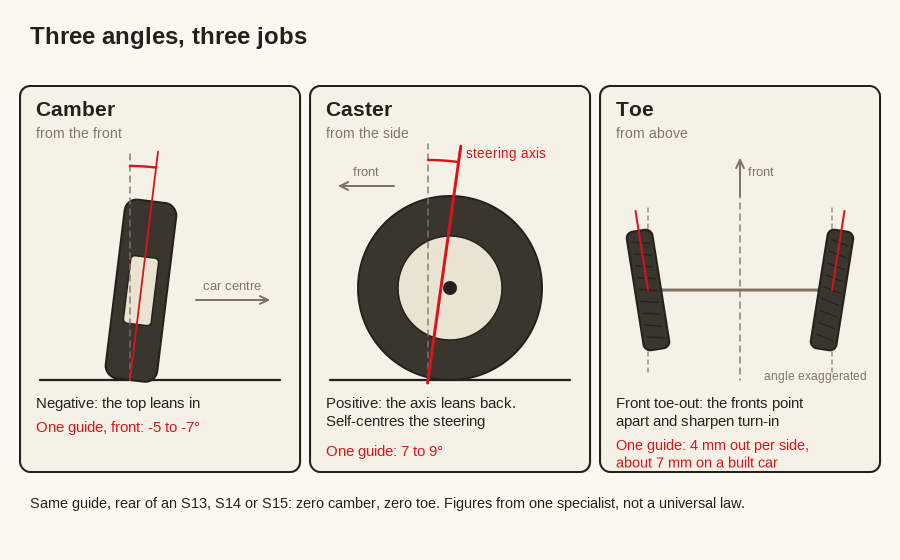
Caster is the quiet one. More of it self-centres the steering, which is why a well set-up drift car seems to come back out of countersteer by itself.
One specialist's drift guide suggests -5 to -7 degrees of front camber, 7 to 9 degrees of caster, 4mm of front toe-out per side daily and about 7mm on a built car, with zero camber and zero toe at the rear of an S13, S14 or S15. Figures from one guide, not a universal law.
What To Fit, And What It Costs
The S14's problem is a standard parts list that was never built for minus seven degrees of anything. The front is MacPherson strut, with no factory camber adjustment on most cars in this class. The rear is independent multi-link, also with no factory camber adjustment. Toe is factory-adjustable almost everywhere, which is why the easiest geometry change is also the cheapest.
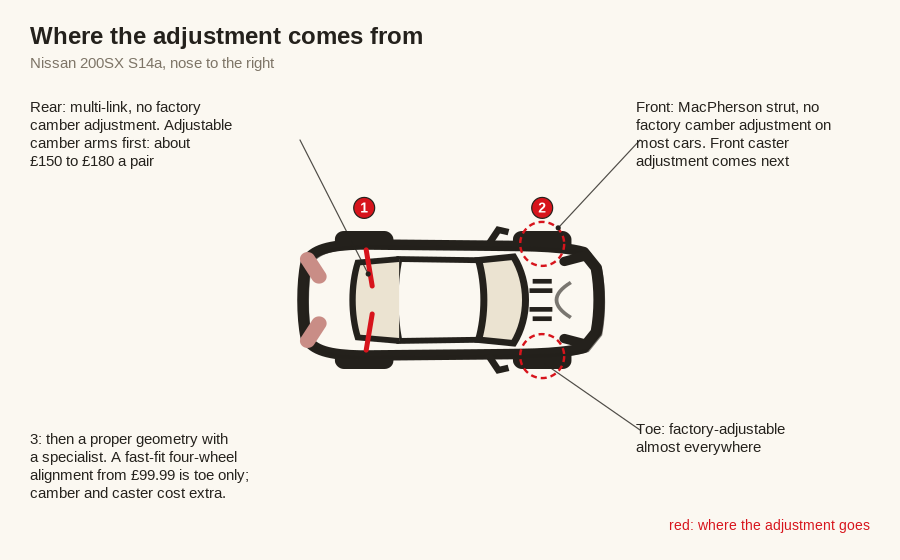
So the first geometry buy is a pair of adjustable rear camber arms. At the time of writing, a pair of Driftworks S14 arms is £150 at Tarmac Sportz; Japspeed S14/S15 arms are £157.99 inc VAT at Mods4u; the UK range sits around £150 to £180. Front caster adjustment comes next. Then book a geometry with a specialist. Halfords' four-wheel alignment from £99.99 is toe only; camber and caster are charged separately.
The Catch
Negative camber is not free: it chews the inner edge of the tyre and hurts straight-line braking. High caster makes the steering heavy, which is fine with power steering and miserable without.
The MOT bites in quiet ways. A tyre fouling the vehicle at the time of test is a Major defect. Missing or misadjusted lock stops are Major if they were standard. Tell your insurer about every change; undeclared modifications can void a policy or get cover cancelled.
Sort the safety kit, tyres and brakes first. Then a pair of rear camber arms and a proper alignment, before you think about more power. Three angles, three jobs: camber tilts, caster leans the steering axis, toe swings the wheel. These settings belong on a drift day. On the road they chew tyres and make the car darty, which is right for the track and wrong for the shopping.
Where our facts came from
- Wikipedia: Camber angle (opens in a new tab) reference
- Wikipedia: Caster angle (opens in a new tab) reference
- Wikipedia: Toe (automotive) (opens in a new tab) reference
- Nissan Motor Corporation: Silvia K's Type S (1994) — Nissan Heritage Collection No. 198 (opens in a new tab) manufacturer
- Chase Bays: The Drift S13 S14 S15 Guide — 180SX / 240SX / Silvia (opens in a new tab) press
- Scarles: Drift Car Alignment: What do Toe, Camber, and Caster Actually Do? (opens in a new tab) press
- GOV.UK (DVSA): MOT inspection manual: Section 5 — Axles, wheels, tyres and suspension (opens in a new tab) official
- GOV.UK (DVSA): MOT inspection manual: Section 2 — Steering (opens in a new tab) official
- Howden Insurance: Declaring modifications to your car insurer (opens in a new tab) press
- Tarmac Sportz: Driftworks Nissan 200SX S14 (93-99) Rear Camber Arms with Rod ends (opens in a new tab) press
- Mods4u: Japspeed Nissan 200SX S14/S15/Skyline — Adjustable Rear Upper Camber Arms (opens in a new tab) press
- Halfords Autocentres: 4 Wheel Alignment (opens in a new tab) press


