Handbrake entry: locking the rear to start and stretch a drift
What the lever actually does, when drift coaches teach it, what goes wrong, and why a Toyota GR86 can start learning without a single bolt turned.


The handbrake entry is about as direct as a drift trigger gets. A short pull locks the rears, the back end lets go, and the car points sideways. The moment the rears lock is unambiguous and repeatable, which I like in a sport made mostly of smoke.
Coaches teach two uses: initiation on a very tight corner where traditional cornering does not fit, and short stabs mid-slide, during the hold, to stretch or adjust the angle.
The Physics, In Plain Words
A tyre has only so much grip, divided between going forward and going sideways. Lock the rears and the friction equalises in every direction, so the car's inertia carries the back out. A locked tyre has kinetic friction, which is lower than the static friction a rolling tyre enjoys, so it grips less and slides more.
Think of the back of the car briefly going on strike. The front keeps steering; the rear keeps travelling in the direction the car was pointed a second ago. That is a drift, geometrically speaking.
How It Is Done
DirtFish teach a clean three-beat sequence: Clutch, Turn, Pull. With a downshift it becomes Clutch, Pull, Turn. On a manual rear-drive car the clutch must be in before the lever moves, or the engine stalls as the rears stop turning. Throttle stays small while the back swings out.
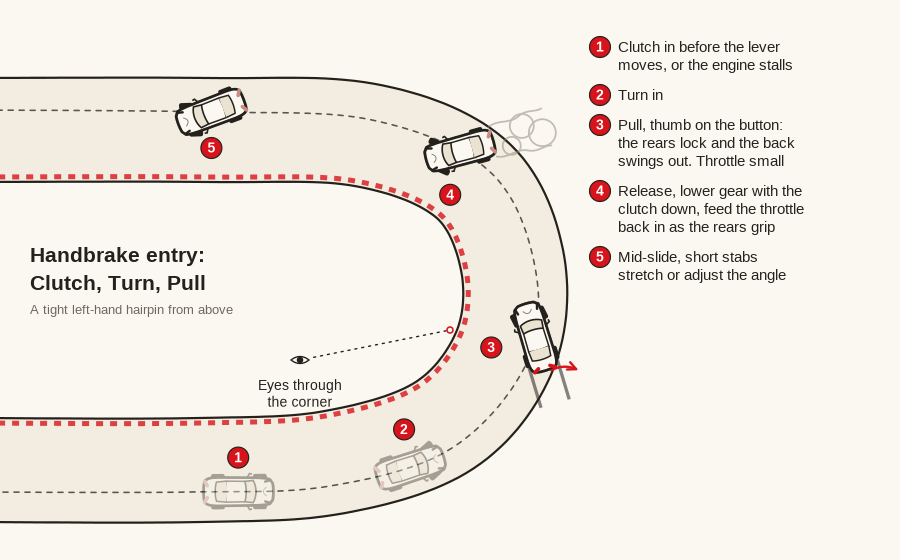
Pull the lever only as far as it takes to lock the wheels, with a thumb on the release button so the ratchet cannot catch. Release, select the lower gear with the clutch still depressed, and feed the throttle back in as the rears regain forward grip.
The Torsen limited-slip differential, which the Toyota GR86 (ZN8) carries across the range, is what makes the throttle do something useful at that point. 231 bhp helps too. The handbrake triggers it; the throttle keeps it alive.
The GR86 uses a traditional pull-up hand-lever parking brake with cables to the rear, which is enough to get started; no electronic parking brake is offered on any trim. A cable handbrake uses a ratchet and takes real force to lock the rears, and repeated heavy drift use can stretch the cables until they fail.
Competition cars fit a hydraulic handbrake because lever travel is proportional to brake pressure at the wheels, so lockup is immediate and you can feather the rear brake the way you would a pedal. A cable handbrake wants muscle. A hydraulic one is a dimmer switch.
Beginners get this wrong in three ways. Approach too slowly and the rear has no energy to carry out when it locks; a polite approach gets a polite failure.
Lift off the throttle completely after the pull and the rear snaps back into grip, the car straightens, and you look slightly silly. Let the ratchet catch mid-pull and the rear brake stays on; that is physics quietly deciding the car is parked now, usually facing the wrong way.
Where To Learn
A skid pan or a licensed drift circuit, with an instructor, is the only sensible place. DirtFish and Team O'Neil teach the handbrake only on closed rally stages, never on public roads, and UK drifting is legal only on private land or an approved track with the venue's permission. Drift Limits at the London Motorsport Academy runs one-to-one drift tuition on three closed circuits.
Where our facts came from
- Toyota (GB) PLC: GR86 Tech Specs (2024) (opens in a new tab) manufacturer
- Toyota (GB) PLC: GR86 Equipment List (2024) (opens in a new tab) manufacturer
- Toyota (GB) PLC: Toyota announces pricing and specification details for the new GR86 coupe (opens in a new tab) manufacturer
- DirtFish Rally School: How to do a handbrake turn (opens in a new tab) official
- DirtFish Rally School: Learn How to Properly Use the Handbrake (opens in a new tab) official
- Team O'Neil Rally School: Hydraulic Handbrakes for Rally, Rallycross and Drift Cars (opens in a new tab) official
- Drifted: Ultimate Hydraulic Handbrake Guide (opens in a new tab) reference
- Drift Limits (London Motorsport Academy): 1:1 Tuition: Drifting and Racing Coaching (opens in a new tab) official
- Wikipedia: Handbrake turn (opens in a new tab) reference
- Wikimedia Commons: File:King of Europe Round 3 Lydden Hill 2014 (14356011899).jpg (opens in a new tab) reference
- Motorsport UK: National Competition Rules 2026: Circuits and Venues (opens in a new tab) governing-body


