Corner types: hairpins, sweepers and chicanes
Why a hairpin rewards patience, a sweeper rewards nerve, and every apex you pick is really a decision about the next straight.


A circuit is a sequence of corners, not a collection of them. Every apex is a decision about the next straight, and the line is worked back from the last corner. Reference car: the BMW E36 coupé in track-day trim, a 328i at the sensible end, an M3 Evolution (S50B32, 316 bhp) at the serious one. Front engine, rear drive; no E36 ran four-wheel drive.
The Physics
A tyre has a slip range, and grip peaks at the top of it. Too aggressive a turn-in, or too high an entry speed, and it is pushed past that range; the tyre starts to roll onto its sidewall and grip falls away. Extra steering mid-corner does the same: load moves through the suspension into a tyre already near the limit, and your second input pushes it over.
The lesson is single-input steering: one turn at entry, held through the corner, unwound on exit, no corrections in the middle. Think of it like pouring a full pint. A single smooth tilt and it arrives; a second nervous waggle and it does not.
How It Is Done
The eyes go first, with a long focal point through the corner; the steering follows. Hands quiet, head still, no sawing at the wheel.
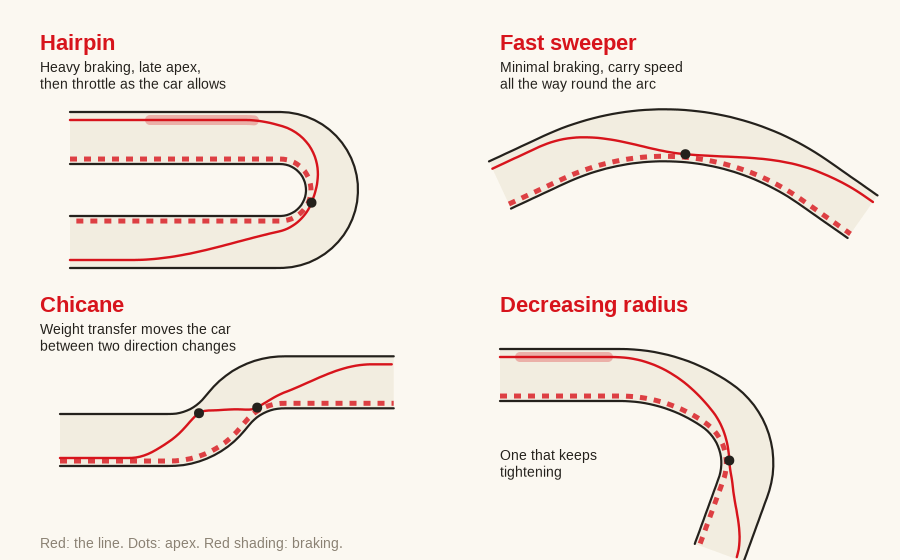
For a corner that leads onto a long straight, brake early, turn in late, and apex late: two-thirds to three-quarters of the way round. Use the full width of the track on exit. The late apex buys exit speed, and the straight multiplies it. For a corner onto a short straight, brake later, turn in slightly earlier, carry speed to the apex, and position for whatever comes next.
Hairpins often follow a long straight, so the heavy braking makes them make-or-break for lap time. Straight after the apex the wheel should start to unwind, and the goal is full throttle before the outside front tyre reaches the exit kerb, car permitting.
A fast sweeper is the opposite job: minimal braking, carrying speed through the whole arc. Most drivers take too long through a chicane; the trick is using the car's own weight transfer to move it between the two direction changes. Treat a double-apex as two linked corners, a decreasing-radius as one that keeps tightening; a long constant-radius bend, pretty as it looks, as a hairpin that eats front tyres.
Common Mistakes
If the wheel will not unwind after the apex, the corner is telling you about a mistake a second ago. Four usual suspects: turned in too early, turned in too fast, throttle too early, too much apex speed. Each forces more steering and bleeds grip. The other classic is human: eyes drift to a hazard, and the car follows like a dog on a lead.
A track day, a skid pan or an ARDS-approved race school, with an instructor who can watch the car and tell you which of those four mistakes you are making. Motorsport UK's Perfecting Your Racing Line tutorial is a sensible place to start before you go. Not the public road. That was true a lap ago; it is true now; it will be true at the chequered flag.
Where our facts came from
- BMW Group Classic: BMW M3 Coupé (E36), 321 hp (opens in a new tab) manufacturer
- BMW Group Classic: BMW 328i Coupé (E36) (opens in a new tab) manufacturer
- Driver61: Master Different Corners & Techniques On Track (opens in a new tab) press
- Motorsport UK TV: Perfecting Your Racing Line (opens in a new tab) governing-body
- Wikipedia: Chicane (opens in a new tab) reference
- CAT Driver Training: Single Input Steering — Your Secret Weapon on Track (opens in a new tab) press
- Motorsport Prospects: The 7 Technical Corner Types in Racing (opens in a new tab) press
- Blayze: Maximize Exits out of Hairpins (opens in a new tab) press


