Late apex vs early apex: which corner wants which
Pick the apex that feeds the straight, not the one that feels natural at turn-in, and the exit speed on the next lap answers the question for you.


The apex is the point where your car touches the inside of a corner. A late apex sits further round the turn, with turn-in delayed. An early apex sits before the centre, with the driver turning in sooner. Which you pick is not a style choice.
It is a trade between entry speed and exit speed. On track, I think the exit wins more often, because it writes itself down the whole straight that follows.
The Physics
Grip is a budget. Decrease the radius of a corner and you must decrease your speed through it, because the tyres can only ask so much of the road at once.
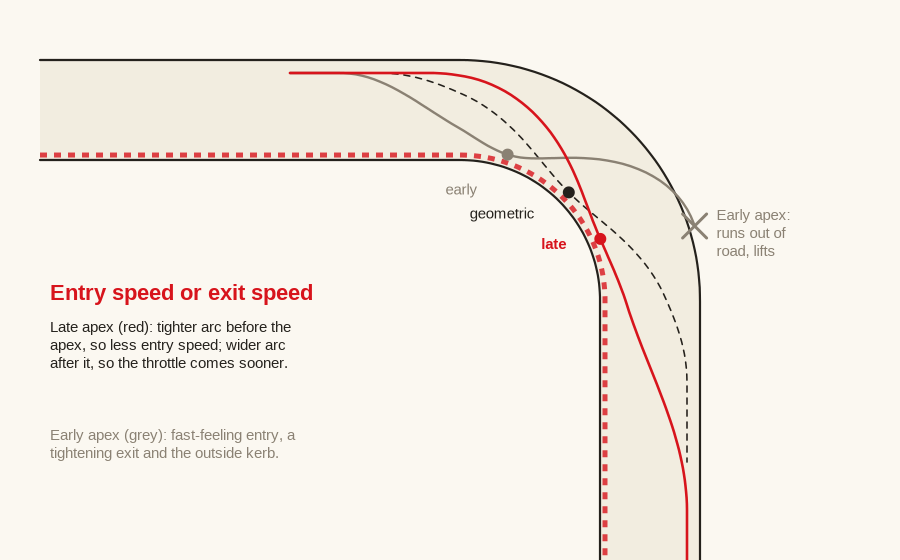
A late apex trades entry radius for exit radius. The arc before the apex is tighter, so the entry speed has to come down. Past the apex the arc opens out, so you can wind the steering off sooner and feed in throttle on the way to the next straight.
High Performance Academy (HPA) estimates the late-apex exit is worth about 2 to 3 km/h (about 1 to 2 mph) over the geometric line. Trivial on a stopwatch at the exit. Not trivial a kilometre later, where everyone else is doing the same maths.
How To Take It
A corner runs outside-in-out. Start wide, decrease the radius towards the apex, then open the steering on exit. A late apex is the same shape, with turn-in held a moment longer and the braking carried a shade later. The aim is that the wheel is already unwinding as you start feeding in throttle. Pressure trades with lock, in a smooth fade, not a snatch.
Before any of that, walk the corner. HPA's suggestion is to look for the bit of kerb with the most rubber on it, laid down by the drivers who went before you. No stopwatch, no telemetry, just a stroll and a look at a kerb. If you ever wanted trackside advice that doubles as sightseeing, this is it.
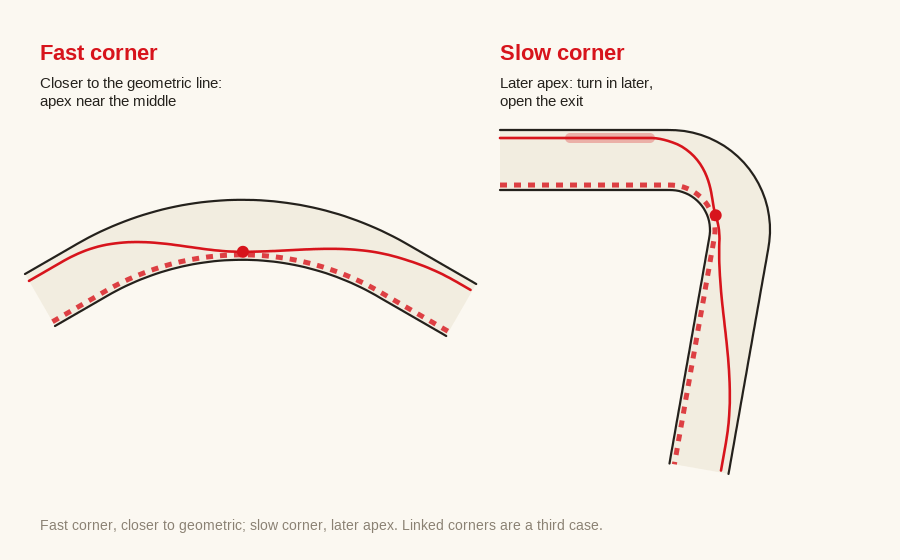
On fast, flowing corners the rule flips. Ross Bentley's rule, repeated by every coach who ever held a clipboard: fast corner, closer to the geometric line; slow corner, later apex. Linked corners are a third case. Give up the apex of the first turn to set up the exit of the last.
Where It Goes Wrong
The signature error is apexing too early. You turn in by instinct, clip the inside too soon, and the car finishes the corner pointing at the kerb on the outside.
The signs arrive in order: running out of road on exit, needing more lock, unable to feed the throttle in. Early apex is what you call it the first time. Running out of road is what you call it next.
Not every early apex is a mistake, mind. In linked corners a deliberate one sets up the exit of the following turn. It is the unintentional one that bites.
Track days with tuition, skid pans and licensed driving schools are the place to try one apex, then the other, and feel the difference through the seat. Karting counts too. Walk the corner first, then go and leave it all out there.
Where our facts came from
- Wikipedia: Racing line (opens in a new tab) reference
- Driver61: How to Drive the Perfect Racing Line (opens in a new tab) press
- High Performance Academy: Race Driving Fundamentals: Understanding the Apex (opens in a new tab) press
- The Drive: Let Team O'Neil Show You How to Find the Perfect Racing Line (opens in a new tab) press


