Threshold braking: finding the limit before the tyres lock
By the end of this you will understand why the hardest brake pedal you have ever pressed is still, probably, not hard enough on a track day.


Threshold braking is asking a tyre for everything it has, not a bit more. Push to the maximum force tyres will take without locking: harder, and they slide; softer, and you throw away stopping distance. Find that thin line and the car stops in the shortest honest distance it can. The coaching material agrees: on track, this is the foundation everything else sits on.
The Physics
A tyre is not a light switch. Grip builds as you ask more of it, peaks when the contact patch slips a little against the road, then falls off a cliff. That peak lives at around 10 to 15 per cent slip, a number you cannot see, cannot feel, and will never read on a dashboard.
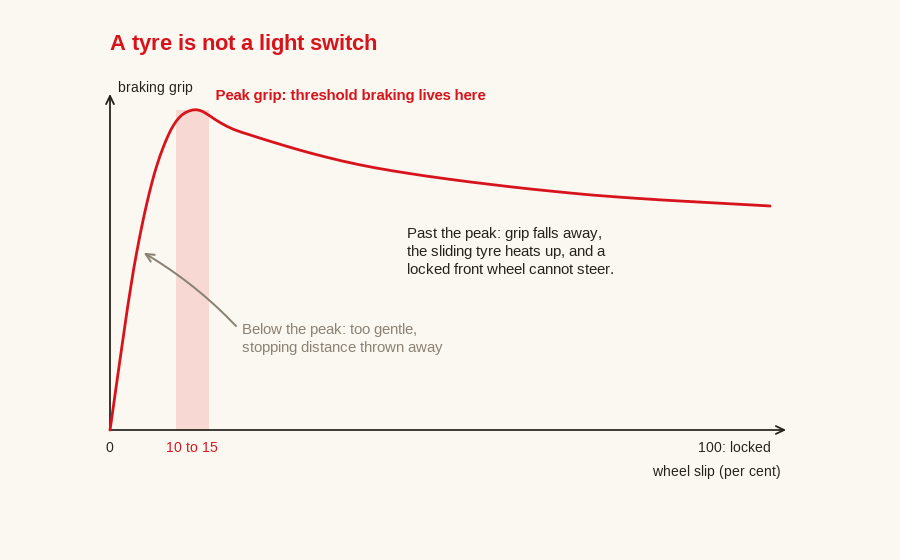
Past it, rolling grip drops away and a sliding tyre heats up and loses more of it. A locked wheel does not stop the car better; it stops it worse, and it cannot steer, which turns the front axle into a directionless brick.
Braking itself helps. Weight shifts forward onto the front tyres, pressing them harder into the road, and they have more grip to spend than most drivers ever ask for.
Doing It
Maximum braking happens in a straight line, before turn-in. Pick a braking point, and press the pedal firmly and progressively. Not a jab, not a creeping squeeze. Hardest at the start, when speed is highest and the nose has pitched forward onto the front tyres. Ease off as the car slows: pressure that was fine at the start will lock the fronts near the end.
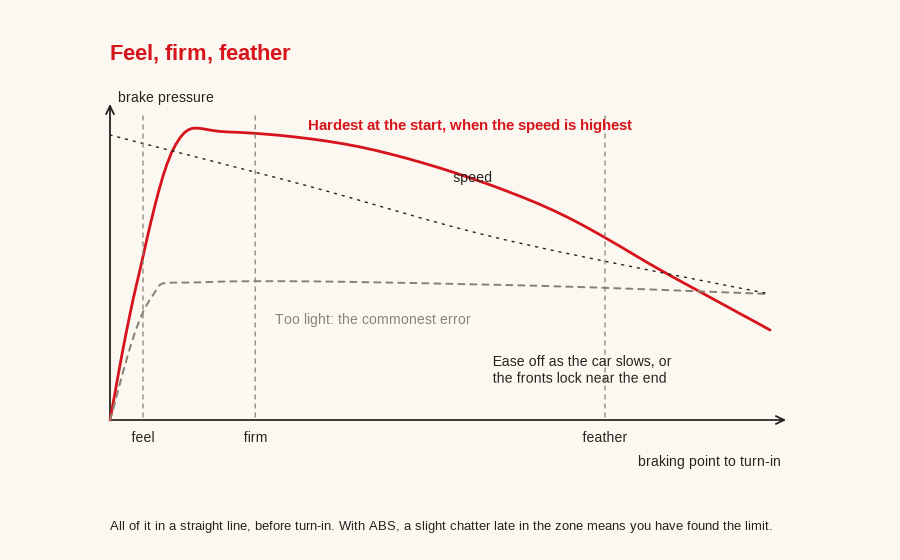
CAT Driver Training teaches it as three phases: feel, firm and feather. Feel for the pedal. Firm into the serious pressure. Feather off as your eyes move to the apex. Most cars on a track day have ABS, which does the job faster than any human. The signal is a tiny chatter at the end of the zone: the car saying, politely, you have found the limit.
The commonest error is not braking too hard. It is braking too lightly, because the driver has never found the limit. Most people's first problem on a track day is not bravery, it is politeness: pedal inputs good for a roundabout, nowhere near what the car can take. The other mistake is braking hard into the corner, which asks tyres to steer and stop at once.
Where to Learn
Nowhere on the public road. Threshold braking is practised at track days, skid pans and licensed race schools, with run-off, marshals and an instructor who can tell you, without flinching, that you are braking far too gently. In the UK, those are the ARDS member schools running the National B licence test under Motorsport UK. Learn it there, and trail braking is within reach.
Where our facts came from
- Wikipedia: Threshold braking (opens in a new tab) reference
- CAT Driver Training: Threshold braking (opens in a new tab) official
- CAT Driver Training: Threshold braking & trail braking (opens in a new tab) official
- Porsche Club of America, Rocky Mountain Region: Threshold Braking (opens in a new tab) official
- Team O'Neil Rally School: Threshold braking (opens in a new tab) official
- Association of Racing Driver Schools (ARDS): About ARDS (opens in a new tab) governing-body
- Pelican Parts (Physics of Racing): The Physics of Racing, Part 23: Braking (opens in a new tab) reference


