Heel and toe: matching revs on the way down
Heel and toe is a braking technique with a downshift tucked inside it, rehearsed in a stationary car first and on a track day after.


Heel and toe is braking with a downshift fitted inside it. The right foot stays on the brake and rolls across to blip the throttle, matching the engine's revs to the lower gear before the clutch comes out. Done well, instructors say, the car doesn't feel the gear change. Done badly, the clutch engages on a slow engine, the drivetrain jolts, and the driven wheels can briefly lock.
The Physics
In a lower gear the engine spins faster for the same road speed. Drop from fifth to third at speed, let the clutch out, and the engine is suddenly lagging well behind the wheels. Something has to give. Either the wheels drag the engine up to speed, which jerks the whole car against its own brakes and can briefly lock the driven tyres. Or the clutch mediates, wearing itself down to do a job it was never supposed to.
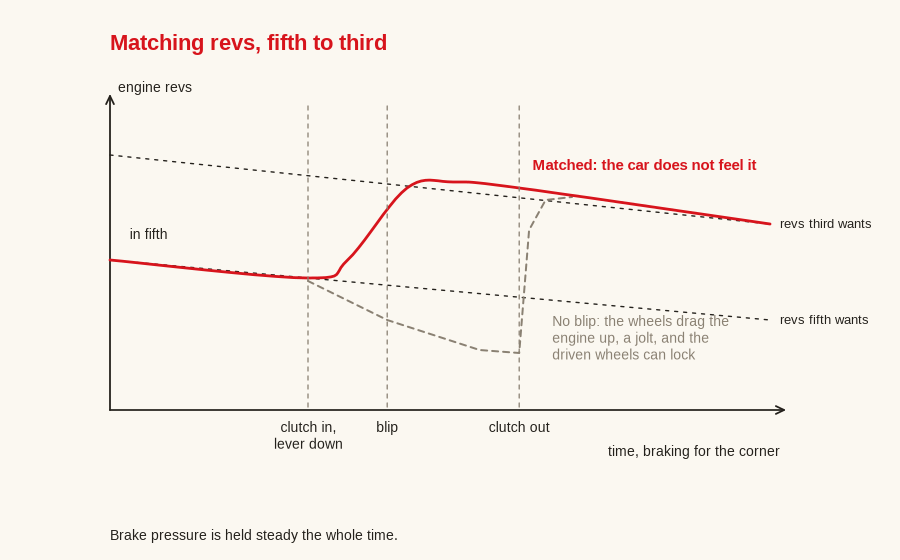
The blip of throttle adds the missing revs before the clutch meets the engine. Think of stepping onto a moving treadmill: match the speed first, then put your foot down. The driveline re-engages smoothly, the suspension stays loaded as the brakes left it, and the car doesn't notice anything changed.
How It Is Done
The order at a track day goes like this. Brake first, hard and in a straight line, and hold the pressure you want through the corner entry. Then, with brake pressure constant, dip the clutch with the left foot and move the lever down a gear. The ball of the right foot keeps braking; the side of it rolls across to the throttle for a short, firm blip. Release the clutch smoothly, and engine and wheels are matched.
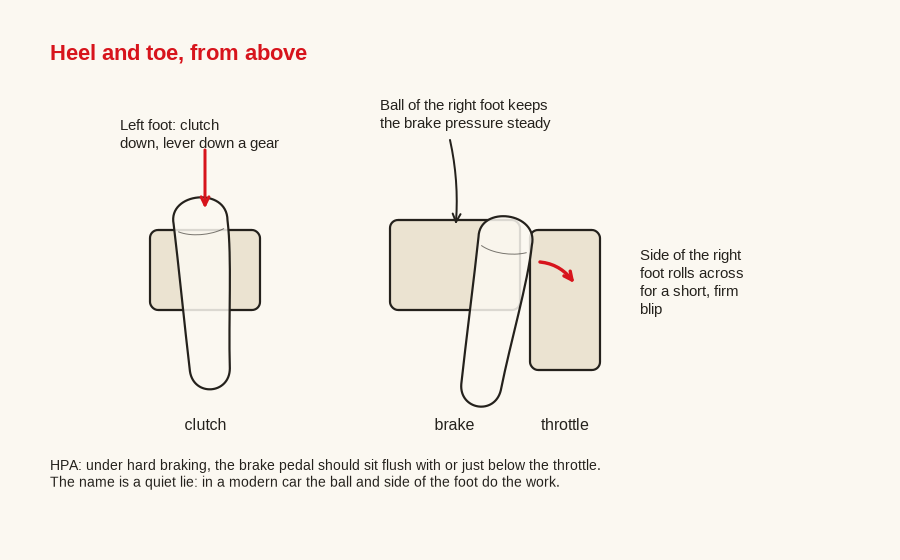
The blip has to happen while the brake pressure holds steady. If it wobbles, the suspension unsettles before the corner. HPA recommends a pedal setup where the brake, under hard load, sits flush with or just below the throttle. On a Porsche the opposite is common: the throttle often sits well below the brake, and PCA notes it may need raising so the side of the foot can reach it.
The usual failure is releasing the clutch before the revs have risen. The engine drags on the driveline, the rear wheels chirp or lock, and HPA warns a bad downshift can snap the back end into oversteer under braking.
The foot must not slip off the brake while reaching for the throttle. Narrow or stiff shoes defeat the roll, and some cars have pedals too far apart for the technique at all. The name, I should add, is a quiet lie: in a modern car it is the ball and side of the right foot that do the work.
Where To Learn
Rehearse the sequence in a stationary car first until the footwork is automatic. Then take it to a track day, skid pan or driving school, away from other traffic, start with first-to-second and second-to-third shifts, and accept slower lap times until the motion lands without thinking. Many modern manuals now fit automatic rev-matching, with a switch to turn it off. GM's version targets within 50 to 100 rpm. Keen drivers still flick the switch.
Where our facts came from
- Wikipedia: Heel-and-toe shifting (opens in a new tab) reference
- evo: How to heel and toe: the motorsport technique for smooth manual downshifts (opens in a new tab) press
- Driver61: How to Heel and Toe (and rev match) (opens in a new tab) official
- High Performance Academy: How to Master Heel and Toe Shifting (opens in a new tab) official
- Honda: Rev Match Control System (opens in a new tab) manufacturer
- Motor1: How Auto Rev-Matching Smooths Out Manual-Transmission Driving (opens in a new tab) press
- Porsche Club of America, Rocky Mountain Region: Heel and Toe Shifting (opens in a new tab) official
- Auto Express: How to drive a manual car: heel-and-toe and rev-matching explained (opens in a new tab) press


