Vision: why fast drivers look further ahead
The best free upgrade on track isn't a tyre or a damper: it's pointing your eyeballs further up the circuit and trusting your hands to catch up.


Where you look is where the car goes. The hands follow the eyes, not the other way round, and one of the cheapest lap-time gains a track driver can find is somewhere above the steering wheel. Driver61's coaching reduces it to one line: look one stage ahead of your position on the circuit. That is the whole trick. The rest of this is just doing as we are told.
The Physics
None of this is about eyesight. It is about taking in more of the circuit. Beginners and anyone in an unfamiliar or faster car do the same thing: the field of vision shortens and narrows, as a survival reflex. Corners then seem to arrive too quickly to process. They have not sped up; the driver has just given themself less time to see them.
Looking further ahead widens peripheral vision, which is trainable, and slows the car's perceived speed. I keep coming back to Land and Tatler's 2001 study, which tracked a racing driver's eye movements and found his head direction closely matched the car's rate of rotation about one second later. His neck was running ahead of his chassis: one driver in one study, not a universal target, but a very suggestive one.
In The Corner
Think of a corner in four stages: brake, turn in, apex, exit. You are always one stage ahead with your eyes. In the braking zone you are already focused on the apex, even if it is hundreds of metres away. From turn-in, you are looking through the corner and visualising the line out. Just before the apex, your gaze moves up to the exit point.
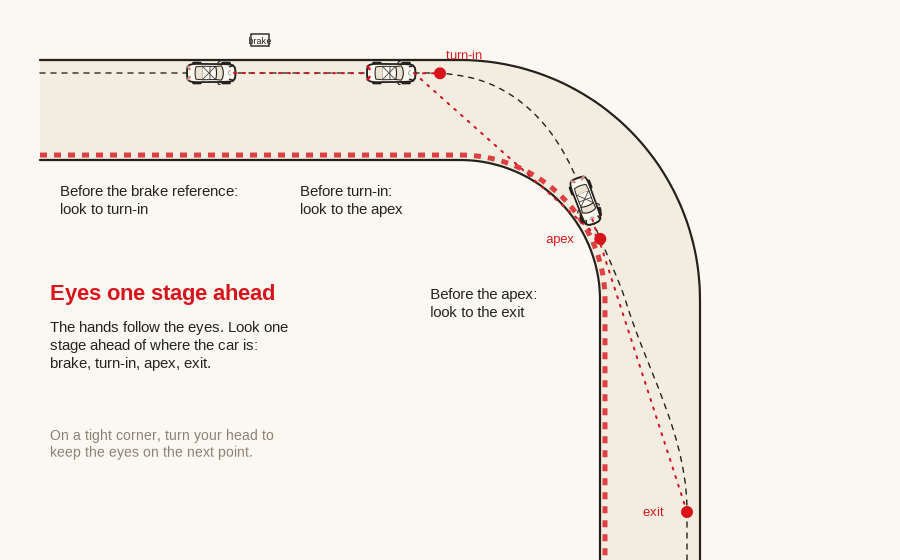
On a tight corner you may need to physically turn your head to keep your eyes on the apex, and that is fine. NASA coaches build the same thing into a sequence. Before the brake reference, look to turn-in. Before turn-in, look to the apex. Before the apex, look to the exit.
With practice, your eyes trace an arc on the track surface a few seconds ahead of the nose. Brains find this strange at first. They adjust. A couple of sessions of deliberately pushing the eyes further on and the habit sticks.
Where It Goes Wrong
Apex fixation catches plenty of drivers. Eyes glue to the apex as the car starts to steer, the entry goes wobbly, and the exit becomes a guess. Wheels find the grass. Under real surprise the brain also prefers to stare at the thing about to hit the car, not the escape route.
Mental fatigue quietly undoes the habit too: the eyes drop, come in, and a familiar chicane suddenly feels rushed. NASA's summary is as neat as it gets: eyes up brings anxiety down, anxiety up brings eyes down.
The habit matters most where corners come at you fast enough for the old instincts to kick in. That means track days, skid pans and licensed driving schools. Practise it there, never on the public road: this is a skill for a circuit, a pan or a classroom with a car on the other end of it. Deliberately look further; let the hands catch up.
Where our facts came from
- Driver61: How Improving your Vision on Track Improves Lap Times (opens in a new tab) official
- Allenberg Racing Schools: In Racing, the Eyes Have It! (opens in a new tab) official
- NASA Speed News (Joshua Allan): Training Your Eyes (opens in a new tab) official
- iRacing (Circle-Track School): Circle-Track School: Line of Sight Behind The Wheel (opens in a new tab) press
- Current Biology (Land and Tatler, 2001): Steering with the head: the visual strategy of a racing driver (opens in a new tab) reference


