Fast driving, explained: where lap time really comes from
Where the time actually lives on a lap, in what order to learn it, and why the latest braker usually loses to whoever leaves the corner hardest.


The pattern in lap times is boring: the time is almost never where beginners think it is. This is the first part of a series on fast driving, built around one reference car: the BMW E36 Coupe, a 328i or an M3, in track-day trim. Track days, skid pans and driving schools only. Call it the map; the detail is in the other parts.
The Physics In Plain Words
A tyre has a finite grip budget, and it has to share it between turning and either braking or accelerating. That is the friction circle, and it explains almost everything else. Spend all of it braking in a straight line and there is nothing left to turn. Spend all of it turning and there is nothing left for the brake.
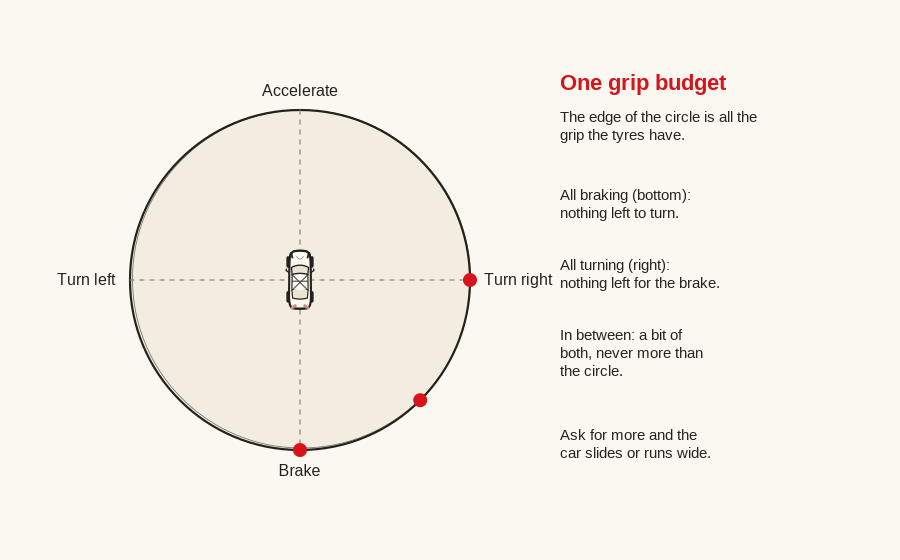
Weight moves around the car as you drive. Brake and the nose dips, loading the front tyres and giving them more grip. Turn and weight slides to the outside wheels. The clever bit is joining those up: let the weight leave the front too quickly at corner entry, and the fronts have less to work with right when you are asking them to turn.
How It Is Done
The coaching books I have read teach a corner in four phases: braking, turn-in, apex, exit. Start with the exit and work backwards. Pick the point where you want the car straight and hard on the throttle, then draw the line that gets you there: usually a slightly later apex than it looks. That line opens the exit, so throttle arrives sooner, and that is where time piles up.
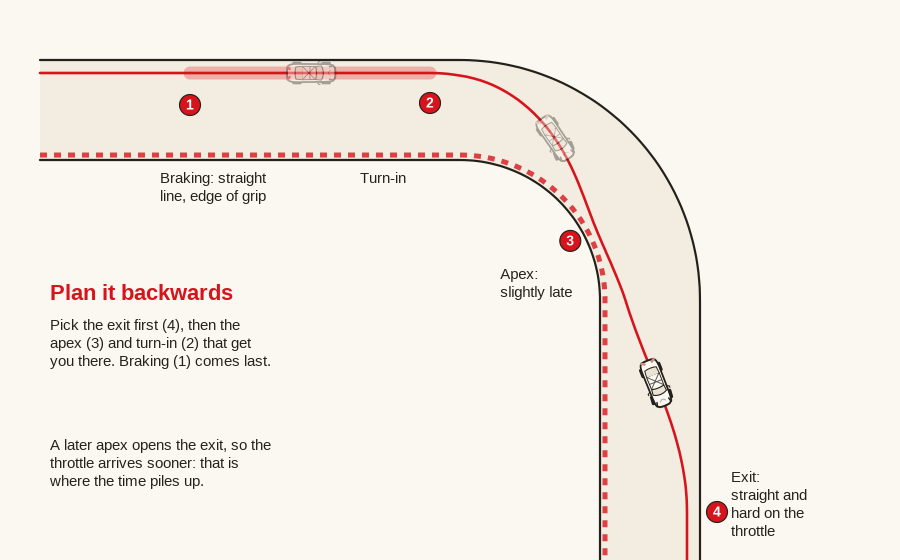
The braking has two jobs. First, slow the car in a straight line, right at the edge of grip. That is threshold braking. Second, bleed the brake off as the steering goes on. Carry a little pressure past turn-in and release it progressively: this is trail braking, and it keeps weight on the fronts exactly when you are asking them to turn.
Vision goes one step ahead of the car: braking point, then turn-in, then apex, then exit. If the eyes are in the right place, the hands and feet tend to follow.
Now the classic mistake: chasing the brake marker. Across eight braking zones on a 90-second lap, late braking is worth around one to two seconds in total. One mph more entry speed per corner can add up to around half a second on an average lap. Braking later than everyone else and still losing to whoever left the corner harder is the standard track-day story.
The other classic: drifting back to an early apex and giving the exit back for free, usually while looking at the bonnet.
Where To Learn
A circuit with instruction, a skid pan or a driving school, every time. In the UK the governing-body route to actual racing is Motorsport UK's ARDS test at an approved circuit: a written paper on Section Q of the Yearbook and the flags, plus a practical assessment. Motorsport UK's Coach Development Pathway includes the 1st4Sport Level 2 Certificate in Coaching Motorsport. Track days sit alongside.
Where our facts came from
- Wikipedia: BMW 3 Series (E36) (opens in a new tab) reference
- BMW Group Classic: BMW 328i Coupe (E36) - product description (opens in a new tab) manufacturer
- Wikipedia: BMW M3 (opens in a new tab) reference
- Driver61: The Ultimate Guide to Braking for Fast Lap Times (opens in a new tab) press
- Driver61: How to Drive the Perfect Racing Line (opens in a new tab) press
- Motorsport UK: Go Racing - ARDS Test and Starter Pack (opens in a new tab) governing-body
- Hagerty: Racing 101 #3: Braking is not a matter of playing chicken (Ross Bentley) (opens in a new tab) press
- Wikipedia: Circle of forces (traction/friction circle) (opens in a new tab) reference


