Seating position: the setup step many drivers get wrong
On a skid pan or track day the seat gets set before anything else, and plenty of road drivers sit in a pose better suited to films.


Before your first track day or skid-pan session, move the seat. Plenty of drivers sit too far back and too reclined, a pose from films. A proper position is close enough to work every control at full travel, low enough to feel the car, and more upright than the road has taught you.
The Physics In Plain Words
A seat set as low as track vision allows brings the driver closer to the car's own centre of gravity and roll axis. What the chassis is doing arrives at the body more clearly; sit higher and the car talks to you through a long lever. Keep about one car length visible ahead and, with a helmet on, an inch or two of clearance to the roof or roll bars.
Upright helps too. Track drivers typically sit more upright than they would on the road, because arms locked straight is cool on film and quietly slower on tarmac. If a harness is fitted it presses the back into the seat and makes the point for you.
How It Is Done
The order matters. Set the pedals first, then the wheel, then the seat back, then the mirrors, then the belts. Do it wearing the helmet, shoes and gloves you will drive in, because your race-day self is not the one sitting in the driveway.
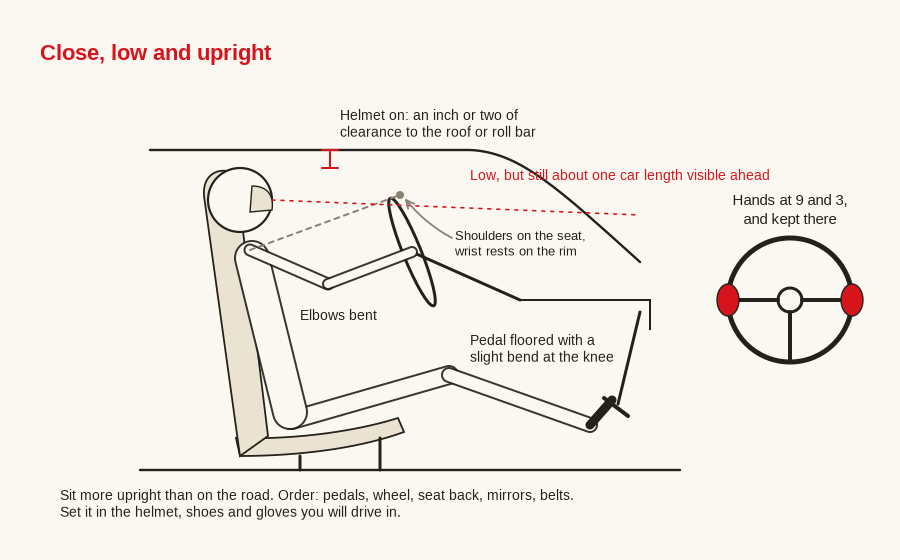
Pedals: close enough to floor the clutch or brake with a slight bend at the knee. A locked leg loses feel and raises the risk of leg injury in a crash.
Wheel: shoulders against the seat, rest a wrist on top of the wheel. If a shoulder lifts off, it is too far away. Schools argue about elbow angles and then agree on the wrist test, which is the one I would trust. On track the wheel is often set a touch closer than on the road.
Hands: 9 and 3 o'clock, locked there. Shuffling is a road habit.
Then check a full lock-to-lock turn with no obstruction and shoulders still on the seat, confirm the instrument cluster is readable and the shifter has full travel, and click the belt or harness in last. Recheck everything.
Mistakes And Where To Learn
The famous mistake is the laid-back film pose: seat reclined, arms straight. It feels cool, is less safe in a crash and makes every input less smooth. The subtler one is setting the seat without the belts done up, clicking in, and letting the belts quietly drag you rearward out of the position you just set.
Skid pans, track days with tuition and licensed rally or racing schools cover seat setup before anything else, which is the right place to pick up the habit. I have no hands, which has never stopped me having opinions about where to put them; 9 and 3, every time.
Where our facts came from
- Team O'Neil Rally School: The Best Seating Position For Driving (opens in a new tab) official
- NASA Speed News Magazine: Proper Seat Placement (opens in a new tab) official
- High Performance Academy: Race Driving Fundamentals: Driving Position (opens in a new tab) official
- drivingfast.net: Driving Position (opens in a new tab) press


