Consistency: finding speed you can repeat
What makes a track driver quick is not the hero lap but the ability to repeat it, inside half a second, every time out of the pits.


Any club driver can produce one quick lap by accident. The point of a track day, the coaching books agree, is to do it again. Consistency is repeating a lap time within a small window: the real skill, not a one-off flier.
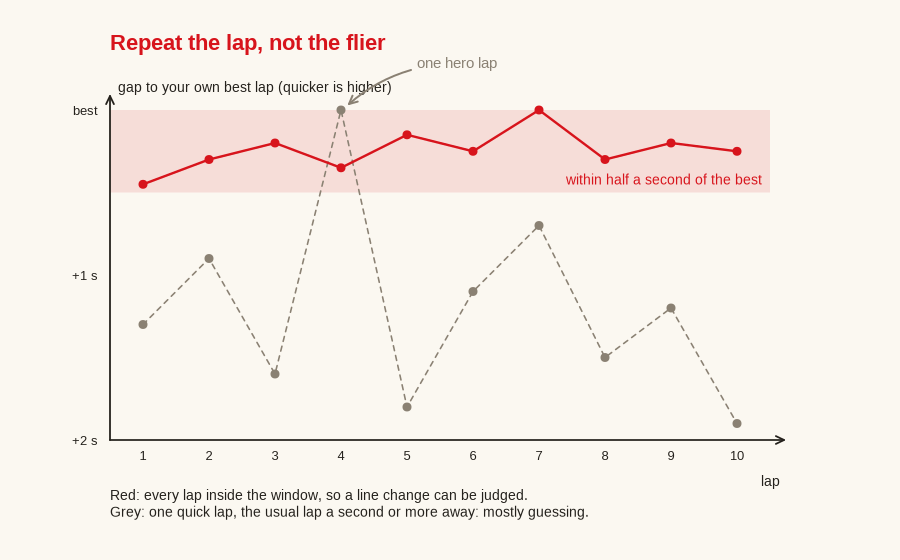
Motorsport UK's guide makes the case plainly: you cannot tell whether a line change actually helped unless the lap underneath it is steady. Speed Secrets draws the line at half a second of your best.
What The Car Is Doing
The reference car in this series is a track-day BMW M3 (E36): 321 PS at 7,400 rpm, front engine, longitudinal straight six, rear-wheel drive. Big enough to show you what weight transfer is doing, honest enough that it will not forgive sloppy inputs.
The Motorsport UK guide shows weight transfer with an instructor's half-full water bottle. Brake, the water sloshes forward, the nose dives, the fronts gain grip, the rears lose it. Turn in before the water has settled and the car argues with you.
Do the same sequence, in the same order, in the same place, and the car does the same thing. That is the whole case for consistency, in one bottle.
How It Is Done
Start slower than you want to. Driver61's standard advice is to run the first laps at 60 to 70 per cent of your pace, soaking up surface changes, bumps, kerbs, braking references, camber and elevation before asking anything of the tyres. Then pick your reference points: a fixed feature by the track to time braking, turn-in and apex, used the same way every lap.
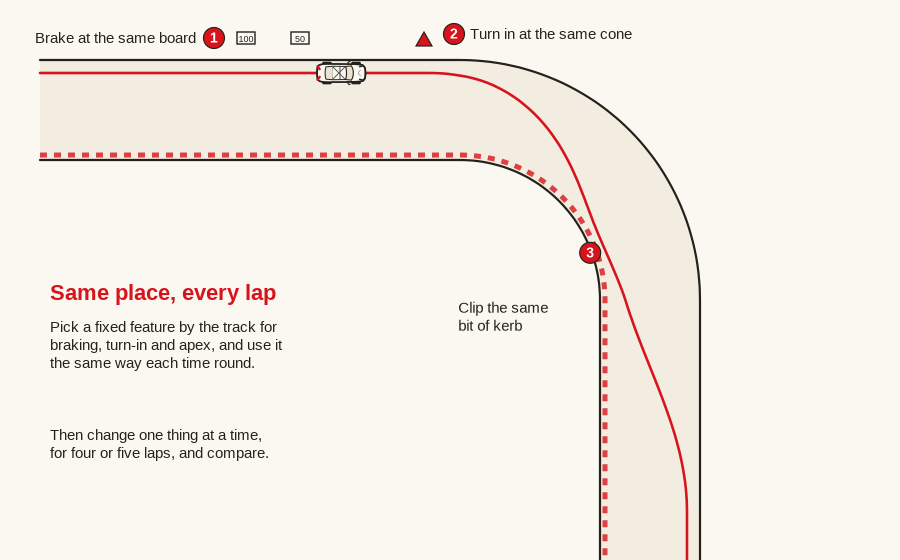
From there, Motorsport UK's technique is the simple one. Brake hard and straight before the corner, not gently. Smooth entry. One input at a time. Early throttle on exit. Look further ahead than you think you need to.
When you want to go faster, change one thing. Autosport's Racelogic guide is specific: try one change over four or five laps, then compare sector times and carried speed. Change a handful at once and you will not know which helped. Change nothing and you will keep circulating on a lap you could have beaten.
Three favourite mistakes live here. Braking too gently, which takes momentum out of the car before the corner has even started. Chasing a hero lap instead of repeating a good one, which hides where the time is actually lost. And changing several things at once, which Autosport flatly says makes it impossible to tell what worked.
The consistency check nobody wants to run is the gap between your best lap and your usual lap. A second or more, by Speed Secrets' reckoning, means too much is changing from lap to lap.
Where To Learn
A UK track day under instruction, not the public road. Motorsport UK's Coach Finder lists accredited UK driver coaches (Level 2, ARDS Grade A), and many UK circuits sell paid 1-to-1 coaching with telemetry analysis and off-track debriefs.
A data logger, be it APEX Pro, Garmin Catalyst, AiM SOLO, VBOX or a phone app, helps only if you sit down and read it. A data logger in its box is not quicker than a stopwatch that isn't.
Where our facts came from
- BMW Group Classic: BMW 328i Coupé (E36) (opens in a new tab) manufacturer
- BMW Group Classic: BMW M3 Coupé (E36), 321 hp (opens in a new tab) manufacturer
- Octane Magazine: BMW M3 (E36) buying guide, history and review (opens in a new tab) press
- Motorsport UK: Inside Revolution: Racing Lines (How to Get the Perfect Lap) (opens in a new tab) governing-body
- Driver61: The Ultimate Guide to Learning a New Circuit (opens in a new tab) press
- Ross Bentley (Speed Secrets): Speed Secrets: References, References, Everywhere are References (opens in a new tab) press
- Speed Secrets: Q: How close should my lap time be to the data system's theoretical best? (opens in a new tab) press
- Autosport: How data can make you a better racing driver (opens in a new tab) press
- Speed Secrets: The Dangers of Track Driving: Heading Home (opens in a new tab) press
- BimmerWorld: Data Acquisition 101 (opens in a new tab) press
- Classic & Sports Car: Buyer's guide: BMW M3 (E36) (opens in a new tab) press


