Holding angle and getting out: the middle and end of a drift
Part eight of Drifting, Explained: how the throttle holds the slide, the hands match it, and how to end a drift without snapping back the other way.


Initiation and transition we covered earlier in the series. This part is the last two of the four phases: the hold, which keeps the angle and adjusts the line, and the exit, which brings the car back to straight without the rear whipping across centre.
The Toyota GR86 (ZN8) is our reference: 2.4-litre flat-four, 231 bhp, six-speed manual, Torsen LSD, and a cable hand lever on the centre tunnel. On paper it has everything it needs.
A drift is deliberate oversteer with loss of rear traction, held under control. The rear tyres have been pushed past their grip limit and are sliding, while the front tyres keep grip and point the car. The smoke is the visible sign of those rear tyres saturated and spinning.
Picture a chair on a wet kitchen floor: shove the back sideways and you can still steer by the front legs. The weight does the quiet work. Accelerating shifts load onto the rear axle and the rear squats. Lift off mid-corner and load piles onto the nose, the rear goes lighter still. The throttle, not the wheel, is doing most of the actual driving.
How to Hold It
Once the rear is sliding, the slide is controlled by throttle and countersteer together, not either one alone. More throttle loads the rear past the limit and grows the angle. Less throttle lets the rear find grip and shrinks it. The hands match the slide.
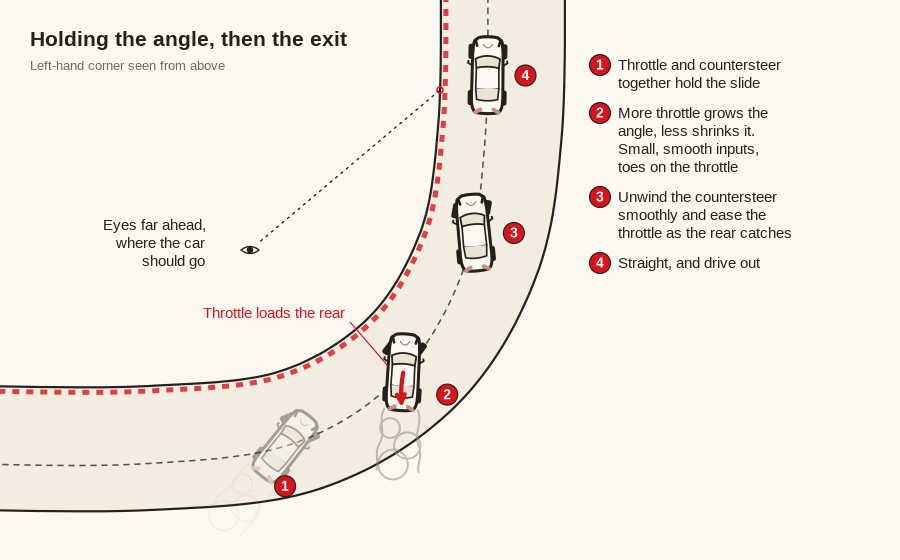
Countersteer is turning the wheel in the direction the rear is heading, with no more lock than the car needs. Schools drill small, smooth inputs rather than big swings. Toes on the throttle, not the whole foot. Eyes far ahead, at where the car should go, not at the ground near the bumper.
The rally school DirtFish teaches it in one line: the pedals steer the car, not the wheel. I have never operated a pedal, and I agree with every word.
The exit is where plenty of runs come undone. Unwind the countersteer smoothly and ease the throttle down as the rear catches. Get back on the power while the car is still sideways and the rear lights up again, which is a very public way to spin.
Where It Goes Wrong
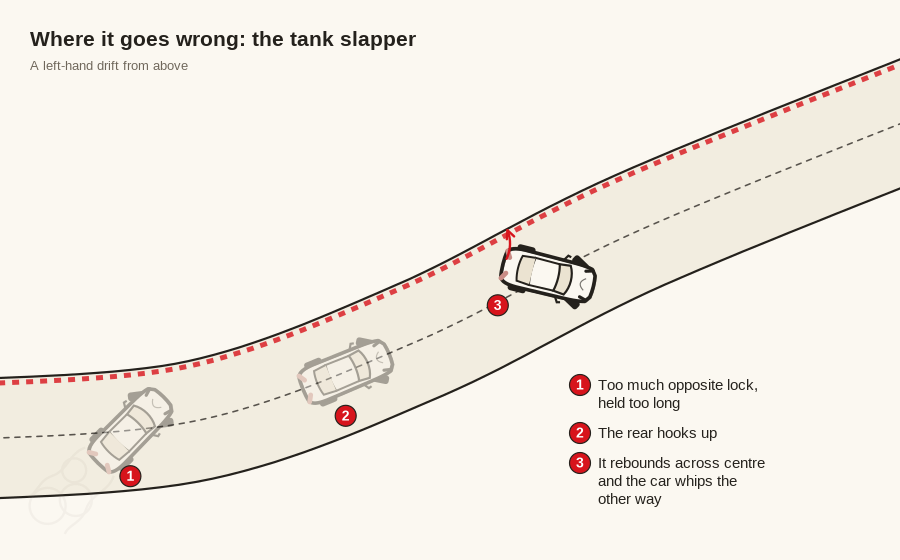
Over-correction is the classic one. Too much opposite lock held too long, and when the rear hooks up it rebounds across centre and the car whips the other way. That is a tank slapper, and it is usually the driver's reply to the slide, not the slide itself: the car doing exactly what you asked, twice, in opposite directions.
The instinct to lift mid-corner is the other killer: as above, the rear goes light and can lose more grip, which is precisely what you don't want on exit.
Where to Learn
Not on the road. A skid pan, a licensed drift school or a dedicated drift circuit, with an instructor in the passenger seat and plenty of runoff. Porsche's Track Experience teaches induction on day one and holding and exiting on day two, with a full lap sideways on the drift circuit as the stated finish. If you can do that, in anything, the hard part is done.
Where our facts came from
- Toyota (GB) PLC: Toyota announces pricing and specification details for the new GR86 coupe (opens in a new tab) manufacturer
- Toyota Motor Corporation: TOYOTA GAZOO Racing Launches the All-New GR86 (opens in a new tab) manufacturer
- Toyota Motor Sales, USA: All-New 2022 Toyota GR 86: Thrills Around Every Corner (press release) (opens in a new tab) manufacturer
- DirtFish Rally School: How to throttle steer (opens in a new tab) official
- Team O'Neil Rally School: How to do a pendulum turn (opens in a new tab) official
- Porsche AG: Slide Rules: the fine art of drifting (Porsche Track Experience) (opens in a new tab) manufacturer
- Wikipedia: Drifting (motorsport) (opens in a new tab) reference
- Wikipedia: Lift-off oversteer (opens in a new tab) reference


